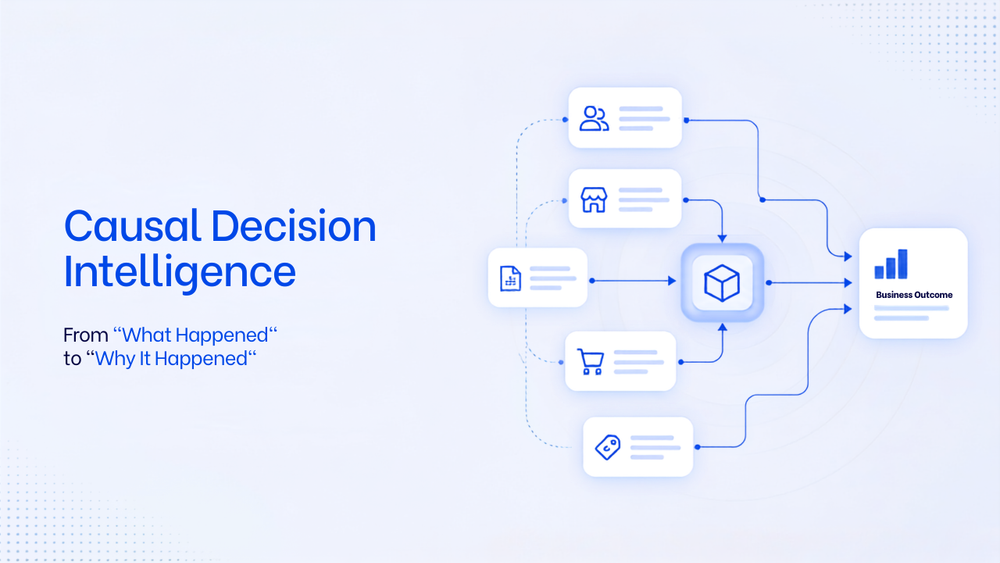
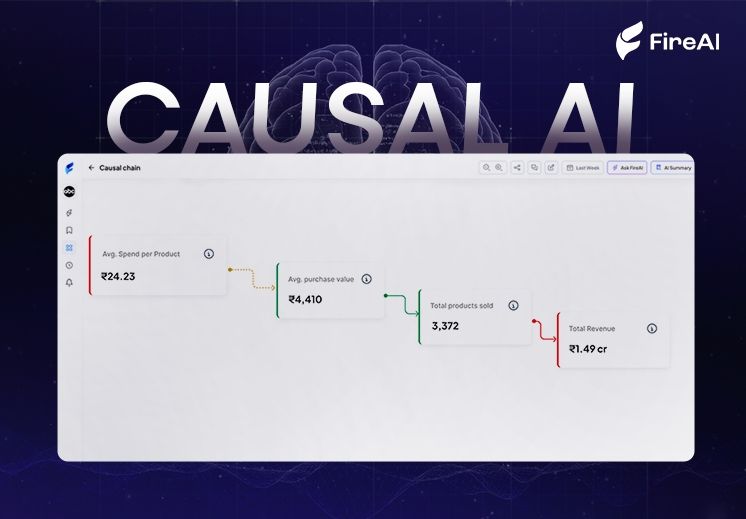
In today’s data-dense business landscape, most organizations rely on machine learning to forecast outcomes — who might churn, what may sell, or how performance may shift.
But prediction alone is no longer a competitive advantage. Leaders now demand deeper intelligence:
- Why did this happen?
- What will change if we act differently?
- Which choices actually improve results?
This is where Causal AI becomes transformative.
While traditional machine learning identifies patterns and correlations, Causal AI uncovers true cause-and-effect relationships, enabling teams to run “what-if” analyses, simulate interventions, and make decisions with proven business impact.
This guide breaks down what Causal AI is, how it works, real-world applications, and how modern teams are adopting it today.
Why Causal AI Matters Now
Traditional ML answers:
- What is likely to happen next?
- Which customers might churn?
- Which products may sell more?
Causal AI answers:
- Why did this trend change?
What would happen if we gave a discount?
Would retention improve if onboarding improved?
Which customers actually benefit from an intervention?
This unlocks:
- Counterfactual analysis (“what would have happened if…”)
- Scenario simulation (“what if we changed pricing?”)
- Personalized interventions with measurable ROI
- Confidence to act instead of guess
Key Concepts in Causal AI
| Concept | Description |
|---|---|
| Correlation vs. Causation | Correlation = association. Causation = changing A actually changes B. |
| Causal Graphs (DAGs) | Visual maps showing how variables influence each other. |
| Structural Causal Models | Mathematical equations describing real causal mechanisms. |
| Potential Outcomes | Compares outcome with treatment vs. without (Rubin Causal Model). |
| do() Operator | Judea Pearl’s tool to simulate forced interventions (do(give_discount) ≠ observe(discount)). |
| Counterfactuals | “What would have happened if we had acted differently?” — powers personalization & uplift modeling. |
How Causal AI Works: Core Techniques
A. Identification Strategies
- Randomized Controlled Trials (RCTs) – gold standard
- Instrumental Variables (IV)
- Propensity Score Matching/Weighting
- Difference-in-Differences
- Regression Discontinuity
B. Modern ML-Enhanced Methods
- Double / Debiased Machine Learning
- Meta-learners (T-learner, S-learner, X-learner)
- Conditional Average Treatment Effect (CATE)
- Uplift modeling
C. Causal Discovery (when the graph is unknown)
- PC, FCI, GES, NOTEARS algorithms
D. Counterfactual Inference
- Simulate individual outcomes under different policies or actions
Popular Tools & Libraries (2025)
| Tool | Best For | Made By |
|---|---|---|
| DoWhy | End-to-end causal workflow (Microsoft + PyWhy) | Open-source |
| EconML | Heterogeneous effects, policy optimization | Microsoft Research |
| CausalML | Uplift modeling at scale | Uber |
| CausalNex | Bayesian causal discovery | QuantumBlack |
Real-World Applications
| Industry | Use Case | Impact |
|---|---|---|
| Marketing & Growth | True campaign uplift, optimal discount targeting | 20–40% higher incremental ROAS |
| Healthcare | Treatment effect estimation, precision medicine | Better patient outcomes, lower trial cost |
| Finance | Causal risk drivers, credit policy simulation | Reduced default rates, compliant decisions |
| E-commerce | Pricing tests, recommendation impact | Higher AOV without cannibalization |
| Public Policy | Program evaluation, regulation impact | Evidence-based policy making |
Challenges & Limitations
- Hidden confounders can bias results
- All causal conclusions rest on testable assumptions
- Effects may not transport across markets or time
- Requires rich, high-quality data
- Higher computational and engineering cost than pure predictive ML
7-Step Roadmap to Adopt Causal AI
- Define the precise causal question
- Draw a causal diagram (DAG) with domain experts
- Choose identification strategy (RCT, IV, matching, etc.)
- Estimate effect using DoWhy / EconML / CausalML
- Refute & validate (placebo tests, sensitivity analysis)
- Deploy as targeting rules, pricing engine, or recommendation policy
- Monitor real-world outcomes continuously
Conclusion: The Future Is Causal
Predictive AI tells you what will happen.
Causal AI tells you why — and how to change it.
Organizations that master causality will:
- Make decisions with confidence, not correlation
- Run fewer failed experiments
- Personalize at scale with proven ROI
- Simulate strategies before risking capital
The era of guessing is over. The era of knowing why has begun.
FAQs
1. How does Causal AI prove ROI?
It directly attributes revenue, retention, or cost changes to specific actions — no more “hope marketing.”
2. Is Causal AI more reliable than A/B testing?
Yes — it works even without perfect randomization and answers individual-level “what-if” questions.
3. Do I need a PhD to use it?
No. Modern platforms (including Fire AI) abstract the complexity — business users ask plain-English causal questions and get answers appear instantly.
4. How fast can we see value?
With clean data and a clear question → results in 1–4 weeks.