
Closing the Data Decision-Making Gap in Indian Business
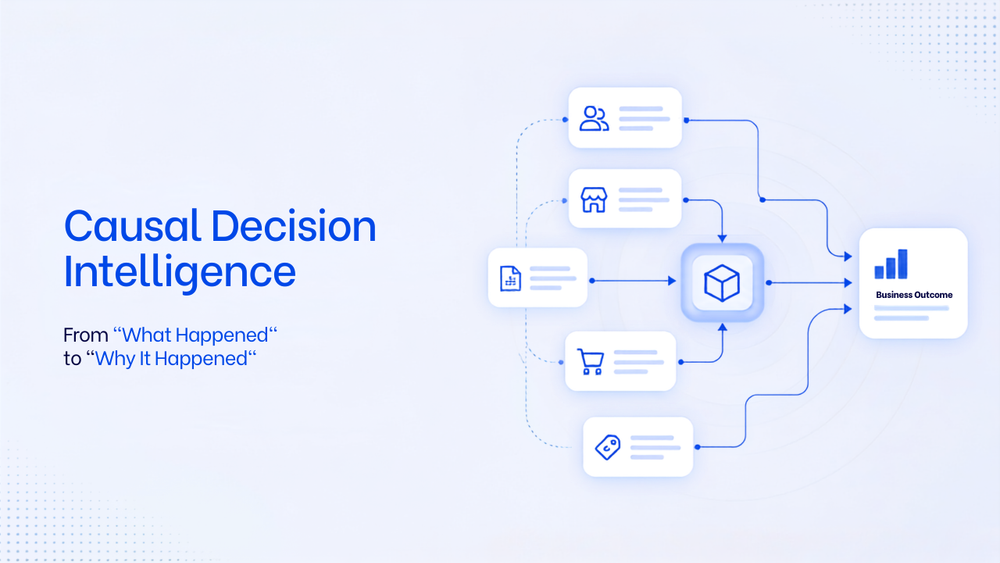
The data decision-making gap is the costly delay between capturing operational data and executing an informed business decision. To close this analytics gap, businesses must move from descriptive dashboards to causal decision intelligence, which explains why metrics change in real time. This guide is for Indian business leaders, operations heads, and financial officers who want to eliminate manual reporting and make decisions within 24 hours of data generation. You will learn the root causes of this gap and a three-step framework to connect, query, and act on your data.
Why Traditional BI Widens the Analytics Gap
Traditional business intelligence tools widen the analytics gap because they require centralized data warehouses and specialized SQL skills to build. Instead of providing immediate answers, they force business teams to wait in IT queues for simple report modifications. A typical dashboard deployment takes 6 to 16 weeks, which is too slow for fast-moving operations.
You can view our detailed comparisons against traditional platforms at /comparisons. For a deeper look at how this compares to general-purpose language models, see our analysis at /comparisons/chatgpt.
| Feature | Traditional Business Intelligence | Causal Decision Intelligence |
|---|---|---|
| Time to first dashboard | 6 to 16 weeks | Days, not weeks |
| Data preparation | Requires ETL pipelines and a data warehouse | Sits directly above existing ERP, SFA, or POS |
| Query interface | SQL queries or complex drag-and-drop | Plain language in 90 text or 20+ voice languages |
| Primary capability | Descriptive (shows what happened) | Causal (explains why metrics changed) |
| Operational cost | High (requires dedicated BI specialists) | Low (business managers query data directly) |
The True Cost of Data Silos in Indian Operations
Data silos isolate critical operational metrics across separate databases, creating a highly fragmented view of business health. When your Tally ERP, sales force automation (SFA) software, and distributor management systems do not share data, managers must bridge the gap manually. This manual compilation consumes 10 to 15 hours per week per regional manager, stalling critical decisions. (Source: FireAI customer data, Q1 2026).
According to a study published by VentureBeat on the Airtable and Forrester Crisis of a Fractured Organization survey, data silos cause employees to lose an average of 12 hours per week chasing information. This operational lag leads to massive revenue leakage. For example, when a regional manager only discovers beat underperformance or product stockouts during the month-end review, the business has already lost weeks of sales.
To estimate your operational metrics before connecting your databases, you can use our free business calculators at /tools.
A Three-Step Framework to Close the Decision-Making Gap
To eliminate the data decision-making gap, businesses must transition from static reports to an active decision layer. This three-step framework allows operations teams to bypass the traditional data warehouse build entirely.
Step 1: Connect Directly to Existing Databases
First, connect your operational databases directly to a decision intelligence platform. Rather than migrating your data or building a new warehouse, use pre-built connectors that sit above your existing ERP, DMS, SFA, or POS systems. FireAI supports 700+ connectors, allowing you to connect sources like Tally, Shopify, and PostgreSQL in minutes. This direct connection preserves your existing workflows while making your data instantly accessible.
Our system is ISO 27001:2022 certified and GDPR assessed by an independent third party, ensuring your connected databases remain secure. Learn more about our compliance at /security.
Step 2: Query in Plain Language
Second, democratize access by allowing team members to query data in their native languages. When managers can ask questions in plain English, Hindi, or any of 90 text and 20+ voice languages, they do not need to wait for a database administrator. According to a McKinsey Global Institute study, knowledge workers spend approximately 1.8 hours per day searching for and gathering information. Allowing teams to query databases directly in their own language recaptures this lost time.
Step 3: Analyze Causal Chains to Find the Root Cause
Third, trace the exact cause of metric movements using causal chain analysis. When a key metric like gross margin or beat productivity drops, a standard dashboard only highlights the variance. A causal chain automatically maps the relationships between metrics, showing you the exact root cause (such as a specific SKU stockout or an unvisited retail outlet). This turns passive data into clear, directed action.
How Daffoworth Pharma Closed Its Reporting Lag
To understand how this framework operates in practice, consider the case of Daffoworth Pharmaceuticals. Before adopting a decision intelligence system, their operations team spent days compiling reports from separate operational systems, stalling critical business decisions.
By implementing FireAI, Daffoworth Pharma connected its databases directly, bypassing traditional BI bottlenecks. This closed the data decision-making gap by turning hours of manual reporting into minutes of automated tracking. (Source: Daffoworth Pharmaceutical Pvt Ltd. case study).
As stated by the team at Daffoworth: "FireAI Analytics has transformed data analysis at Daffoworth Pharma, turning hours of reporting into minutes. Simple, fast, and highly effective for decision-making." This transition enabled their leadership to track property-level performance and sales beats with daily refreshes, accelerating their overall decision cycle.
Across 200+ organisations like Raymond, Noise, and Daffoworth Pharma, closing the analytics gap has meant faster decisions and far less time spent generating reports. Read more about our customer journeys at /case-studies.
Close Your Decision-Making Gap Today
The data decision-making gap is not a data collection problem, it is an access and analysis bottleneck. When operational managers must wait for analysts to compile reports, the business suffers from revenue leakage and delayed responses. By connecting directly to your existing Tally, SFA, or CRM databases, you can deploy your first interactive dashboard within days and begin asking questions in plain language.
Ready to eliminate your reporting lag? Start for Free at app.fireai.in to connect your first data source, or Book a Demo at /get-demo to see FireAI in action.